

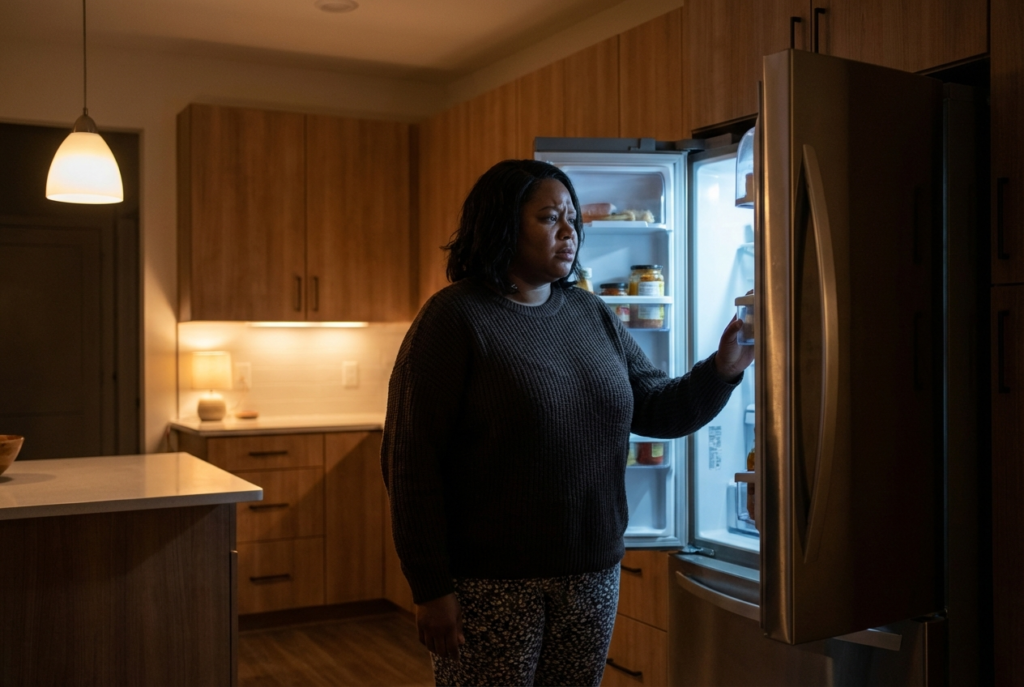
You stopped taking Ozempic. Maybe you hit your goal weight and thought you were done. Maybe insurance stopped covering it. Maybe the side effects finally won. Whatever the reason, the medication is gone — and within weeks, something you weren’t warned about is happening. The hunger is back. Not the polite, manageable hunger you had while on the drug. The old hunger. Loud, insistent, following you around. The food noise has returned. And the scale is moving in the wrong direction, faster than feels possible.
This is Ozempic rebound. It’s real, it’s well-documented, and it’s one of the most common things people aren’t told before they stop.
What the Research Actually Shows
The STEP 1 trial extension tracked participants for one year after they stopped semaglutide: people regained on average two-thirds of their lost weight within 12 months. A 2026 BMJ analysis of 37 studies and nearly 9,300 people found that people who stopped GLP-1 medications regained weight roughly four times faster than people who had lost weight through diet or exercise alone — about 0.4 kg (nearly a pound) per month, with most projected to return to their pre-treatment weight within 18 months.
A University of Cambridge analysis added nuance: regain appeared to plateau after the first year, with many people managing to keep off about 25% of what they’d lost long-term. So the picture isn’t uniformly catastrophic. But the speed in those first 6–12 months is what catches most people completely off guard.
Why the Rebound Hits So Hard
Ozempic rebound isn’t a character failing. It’s a predictable biological response to removing a drug that was managing several interconnected systems simultaneously — and all of those systems reverting at once.
The hunger comes back — sometimes harder
Semaglutide mimics GLP-1, a hormone that slows gastric emptying, signals fullness to your brain, and quiets the neurological drive to seek food. When you stop, your natural GLP-1 levels return to baseline — the same baseline that was already part of why weight management was difficult. Weight loss also lowers leptin (satiety hormone) and raises ghrelin (hunger hormone). When the drug’s suppression lifts, the hormonal rebound can feel more intense than your pre-Ozempic baseline. People describe the food noise returning “with a vengeance.” Clinical data backs this up — increased hunger and cravings in the weeks after stopping are near-universal.
Gastric emptying speeds back up
One of Ozempic’s key mechanisms was slowing how quickly food left your stomach — keeping you full longer. When the drug clears your system (semaglutide has a roughly one-week half-life, so it takes 5–6 weeks to fully clear), your stomach reverts to its previous pace. Meals that felt satisfying for hours now satisfy you for a fraction of that time.
Your metabolism is already running slower
Weight loss — regardless of method — causes metabolic adaptation. A smaller body burns fewer calories at rest, and the body actively works to become more efficient to protect its remaining fat stores. By the time you stop Ozempic, your resting metabolic rate has already adjusted downward. Remove the appetite suppression, and the gap between what you want to eat and what your body needs closes very quickly — in the wrong direction.
Insulin resistance can return
GLP-1 medications improve insulin sensitivity during treatment. When the medication stops, insulin resistance can drift back toward baseline — making fat storage easier and energy regulation less stable. This is part of why regain can feel disproportionately fast. It’s not just eating more; it’s the body becoming more efficient at converting food to fat.
The Timeline: What to Expect
- Week 1 — Little noticeable change. The drug is still partly active. Many people feel fine and assume they’ll be fine.
- Weeks 2–3 — Hunger hormones begin normalizing. You may notice you’re thinking about food more. Portions that felt satisfying start feeling smaller.
- Weeks 4–6 — Full return of pre-treatment appetite patterns. Food noise is back. Gastric emptying has normalized. This is typically when people realize something significant has shifted.
- Months 2–3 — Weight regain is often measurable by now. This is where the pace is fastest — the hormonal environment is fully reverted but habits may not yet have compensated.
- Months 3–12 — Regain continues, typically slowing as the body reaches a new equilibrium. This is the window the clinical data captures — an average of 60–67% of lost weight returning.
Who Rebounds the Most
Rebound is near-universal, but severity varies significantly depending on several factors:
- How abruptly you stopped. Stopping cold turkey creates a sharp hormonal shift. A Danish study presented at the European Congress on Obesity found that patients who tapered off semaglutide gradually maintained their weight for at least six months after stopping, with some continuing to lose modestly.
- Whether you built real habits during treatment. This is the most important variable. People who used the reduced-appetite window to genuinely change what and how they ate — not just eat less of the same things — maintain more of their loss. The medication creates conditions; it doesn’t build habits on its own.
- How many weight cycles you’ve been through. The more loss-and-gain cycles someone has experienced, the more prone their body may be to rebounding quickly. The metabolic “memory” of previous regain cycles is real.
- Whether muscle was preserved during weight loss. Studies suggest 25–40% of weight lost on GLP-1s is lean mass. People who lost significant muscle have a lower resting metabolic rate, making regain easier once appetite returns.
- Stress, sleep, and life circumstances. Cortisol from chronic stress promotes fat storage and drives cravings. Poor sleep spikes ghrelin. These are physiological realities that compound the rebound effect.
What Actually Helps
Taper, don’t stop abruptly
If you have any control over the timing and method of stopping, work with your prescriber on a gradual dose reduction over 4–8 weeks. The goal is to let ghrelin and leptin normalize more gradually, reducing the sharpness of the hunger rebound. This is probably the single highest-leverage intervention available when discontinuing.
Front-load your protein
Without the drug suppressing appetite, protein becomes your most powerful tool. It’s the most satiating macronutrient, it partially slows gastric emptying, and it protects the muscle mass your metabolism depends on. Aim for 1.2–1.5 grams per kilogram of body weight daily. Build every meal around a protein anchor — eggs, Greek yogurt, cottage cheese, chicken, fish, legumes — and eat protein first before anything else.
Build your meal structure before you stop
The worst time to figure out your eating structure is after you’ve stopped and the food noise is back at full volume. Build consistent meal timing, planned snacks, and portion awareness while you’re still on the medication — when hunger is low and willpower isn’t under assault. The structure you create during treatment is the structure you’ll lean on when the drug is gone.
Start resistance training now
Muscle burns more calories at rest than fat, counteracts the metabolic slowdown from weight loss, and makes maintaining weight loss after stopping more physiologically sustainable. Two to three sessions per week — not necessarily intense, just consistent — meaningfully slows the metabolism drop that accelerates rebound.
Treat the food noise directly
The return of food noise is not a test of character — it’s a neurological event. Have strategies prepared: structured meal timing so you’re not making decisions when hungry, keeping high-protein options available so the default choice is a good one, and removing high-calorie trigger foods from the immediate environment. This isn’t about willpower. It’s about reducing the number of moments you have to resist.
Track your weight and act early
Check your weight weekly. The first 2–4 pounds of regain are far easier to address than 20. If the scale is moving up consistently for two weeks, don’t wait — adjust protein, tighten meal structure, increase activity, or contact your prescriber. Catching drift early is the difference between a minor correction and starting over.
Consider whether stopping is actually necessary
Many people stop Ozempic when they reach their goal weight, assuming the medication’s job is done. But obesity is a chronic metabolic condition — the medication was managing it, not curing it. Some people may genuinely benefit from continuing on a lower maintenance dose rather than stopping entirely. This is a conversation worth having with your prescriber, not a decision to make unilaterally.

If You’ve Already Regained: What Now
If you stopped, regained, and are now looking at the number on the scale with dread — this is an extraordinarily common situation. JAMA data found that about a third of people who stopped GLP-1 medications eventually restarted them. That’s not failure. That’s people recognizing that the chronic disease they were managing needs ongoing management.
Restarting semaglutide after a break is generally possible — you may need to restart at a lower dose to re-establish tolerance, particularly for GI side effects. If cost is the barrier, it’s worth exploring telehealth providers who specialize in GLP-1 access, manufacturer savings programs, and whether your prescriber can document medical necessity in a way that improves insurance coverage.
The weight that came back is not permanent. The biology that caused it is manageable. And the tools — both pharmaceutical and behavioral — are the same ones that worked before.
The Bottom Line
Ozempic rebound is real, it’s fast, and it catches almost everyone off guard. Most people regain most of what they lost within a year of stopping. But averages hide enormous individual variation. The people who maintain the most are consistently the ones who built genuine habits during treatment, tapered rather than stopped abruptly, preserved muscle, and caught early regain before it became full regain.
The medication gave you a window. What matters now is what you built inside it — and what support you put in place for when it closed.
Related articles:
- Why Your Weight Loss Has Stalled on Ozempic →
- Ozempic Face: What Causes It and What Actually Helps →
- GLP-1 Side Effects: What Your Doctor Won’t Tell You →
Medical Disclaimer
The content on this page is for informational and educational purposes only. It reflects general user experiences and publicly available clinical information about GLP-1 medications — not personal medical advice. Every person’s health situation is different. Before starting, adjusting, or stopping any medication or treatment, please consult a licensed healthcare provider or specialist who can evaluate your individual circumstances.