You’re not imagining it — constipation is one of the most persistent and undertalked side effects of Ozempic and other GLP-1 medications. Unlike nausea, which tends to fade after a few weeks, constipation can quietly linger for months. The good news? Most people find relief without reaching for harsh laxatives. Here’s what actually helps — naturally, gently, and based on real experience from people who’ve been through it.
Related: why GLP-1s cause constipation and managing gas and bloating.
Why GLP-1 Medications Cause Constipation
Semaglutide (Ozempic, Wegovy) slows the rate at which your stomach empties food into your intestines — that’s partly how it keeps you feeling full longer. But this slowdown doesn’t stop at your stomach. It ripples through your entire digestive tract, giving your colon more time to pull water out of waste. The result: dry, hard stools that are difficult and sometimes painful to pass.
It’s not a sign something is wrong. It’s a known, common side effect — affecting roughly 24% of people on weight-loss doses of semaglutide. And because you’re also eating less food overall, there’s simply less bulk moving through your system to keep things going.
What People in the GLP-1 Community Actually Use
Across Reddit communities like r/Ozempic, r/WegovyWeightLoss, and r/GLP1, constipation relief is one of the most discussed topics. Here’s what comes up again and again:
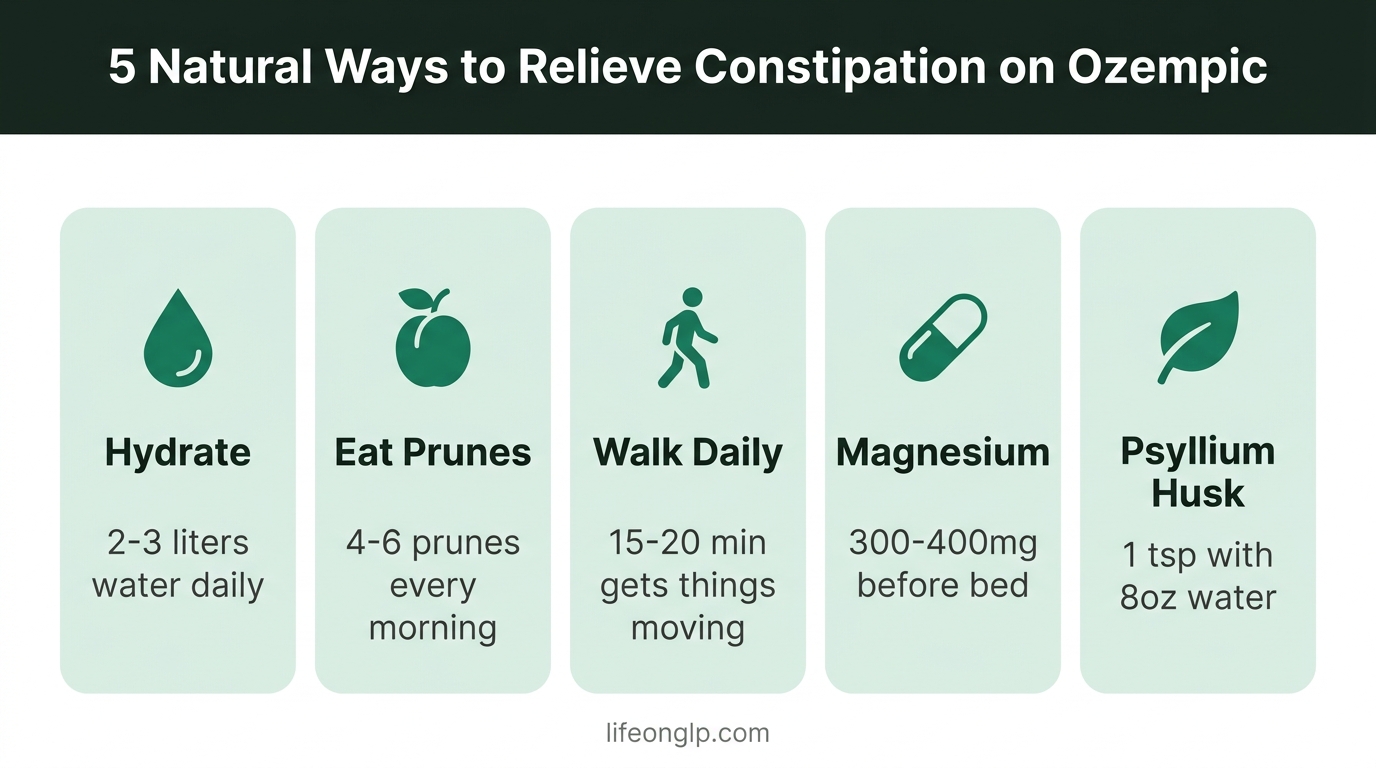
- “Magnesium before bed changed everything for me.” — Magnesium citrate or oxide taken at night is probably the single most recommended remedy in GLP-1 communities. It draws water into the intestines gently, without cramping. Most people take 300–400mg before sleep.
- “I started eating prunes every morning and haven’t had an issue since.” — Prunes contain sorbitol, a natural sugar alcohol that pulls water into your bowel. 4–6 prunes daily is a common starting point.
- “Psyllium husk in the morning with a big glass of water — do not skip the water.” — Psyllium husk is a soluble fiber that forms a soft gel in your intestines, making stool easier to pass. The key is always taking it with at least 8 oz of water.
- “Walking. Just walking. Even 15 minutes got things moving.” — Movement is consistently underrated for constipation relief. Even a short daily walk stimulates intestinal muscle contractions.
- “Warm water first thing in the morning, before anything else.” — A glass of warm or hot water on waking triggers a gastrocolic reflex in many people — essentially waking up the bowels.
⚠ Important Note on Laxatives
Stimulant laxatives like senna and bisacodyl can be effective short-term but are not for daily use on GLP-1s. Dependency risk is real, and overuse can worsen the problem long-term. Start with gentle, natural approaches first — most people find them sufficient.
The Natural Remedy Ladder: Start Here
Think of managing GLP-1 constipation as a ladder — start at the bottom and only move up if needed:
| Step | What to Do | Why It Works |
|---|---|---|
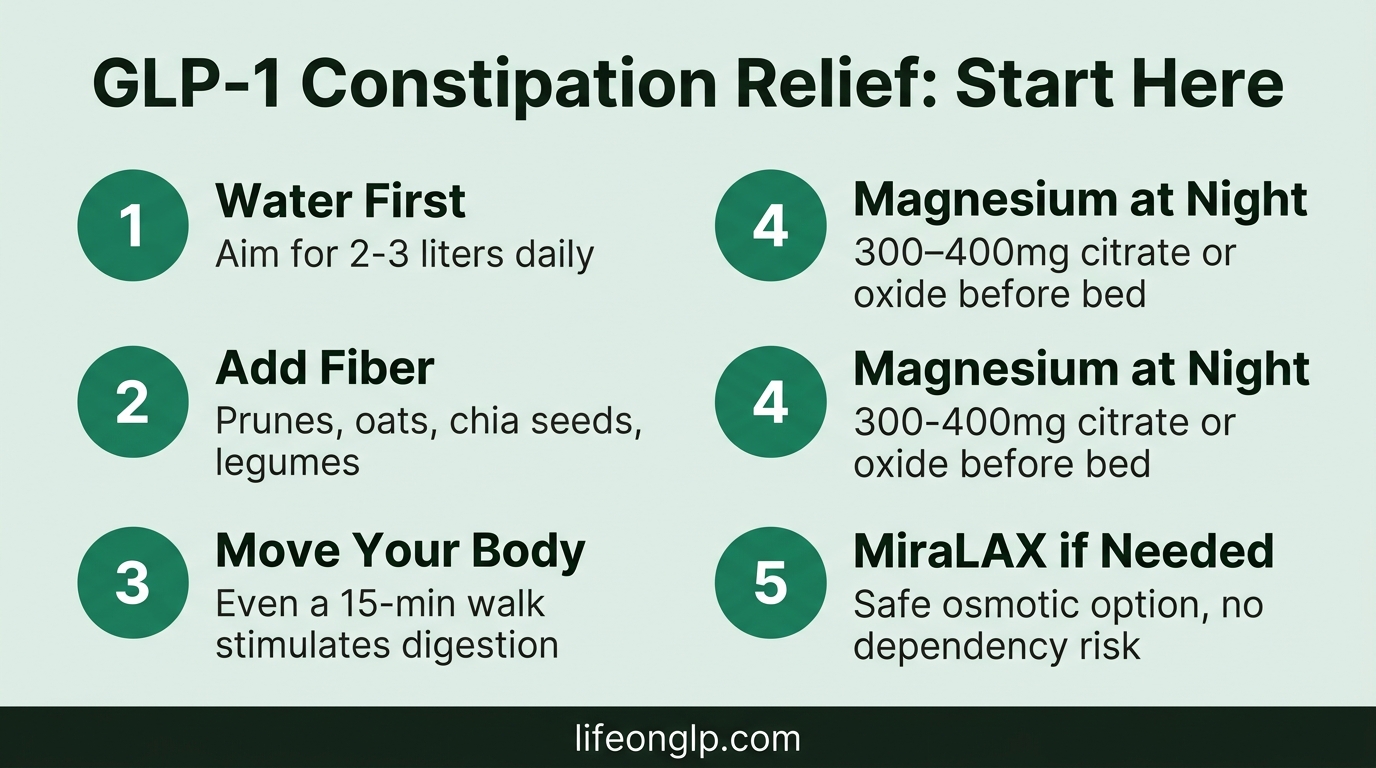
| 1 | Drink 2–3 liters of water daily | Hydration is the single biggest factor in stool consistency |
| 2 | Add 4–6 prunes or a glass of prune juice daily | Natural sorbitol draws water into the bowel |
| 3 | Walk 15–20 minutes daily | Movement triggers intestinal contractions |
| 4 | Take psyllium husk (1 tsp or 2–3 capsules) with water | Adds bulk and softness to stool |
| 5 | Add 300–400mg magnesium citrate or oxide before bed | Gently draws water into intestines overnight |
| 6 | Try MiraLAX (polyethylene glycol) if steps 1–5 don’t work | Osmotic laxative, safe long-term, no dependency risk |
Fiber: The Underrated Cornerstone
Most people on GLP-1 medications are eating significantly less food — which means significantly less natural fiber. The recommended daily intake is 25–35 grams, but on a reduced appetite, many GLP-1 users are getting half that or less.
The fix isn’t just adding a fiber supplement (though that helps). It’s being intentional about fiber-rich foods at every meal:
- Berries — raspberries and blackberries have 6–8g of fiber per cup
- Legumes — lentils, black beans, chickpeas (10–15g per half cup cooked)
- Chia seeds — 10g fiber per 2 tablespoons, and they absorb water to form a gel
- Oats — 4g per serving, plus beta-glucan which feeds good gut bacteria
- Broccoli and Brussels sprouts — both high in fiber and support overall gut health
If food sources aren’t getting you there, a psyllium husk supplement is the most evidence-backed option. Metamucil’s GLP-1 Friendly Psyllium Husk Capsules are specifically marketed for GLP-1 users and easy to take — 3 capsules with water before meals. NOW Foods Psyllium Husk is a no-frills, well-reviewed alternative at a lower price point.
Magnesium: The Community Favorite
If there’s one supplement that comes up most consistently in GLP-1 constipation discussions, it’s magnesium. And for good reason — it works gently, reliably, and without the dependency risk of stimulant laxatives.
There are several forms, and the difference matters:
- Magnesium citrate — most effective for constipation relief, mild laxative effect, fast-acting
- Magnesium oxide — slightly less bioavailable but very effective for constipation; the 400mg-before-bed approach is widely used
- Magnesium glycinate — best absorbed, gentlest on digestion, less laxative effect but still helps
For constipation specifically, magnesium citrate or oxide is what most GLP-1 users report working. GLP-1 SOS™ Digestive Support combines 250mg magnesium citrate with ginger, probiotics, and B12 in one capsule — designed specifically for Ozempic and Wegovy users dealing with multiple digestive issues.
One caution: if you have kidney disease or take medications that affect kidney function, check with your doctor before adding magnesium supplements — high doses can accumulate.
Two Overlooked Tricks That Genuinely Help
1. The squatty potty position. Modern toilets put us in a position that partially closes off the rectum. Elevating your feet on a stool (6–9 inches is enough) to squat changes the anorectal angle and makes passing stool significantly easier. This is especially helpful when stool is hard — it reduces the need to strain.
2. Abdominal massage. A gentle clockwise massage of your lower abdomen — following the direction your colon moves — can stimulate peristalsis. Do it lying down for 5–10 minutes in the morning. It sounds too simple, but clinical studies have found it measurably reduces constipation severity.
When to Talk to Your Doctor
Most GLP-1 constipation is manageable at home. But contact your provider if:
- You haven’t had a bowel movement in more than 7 days
- You have significant abdominal pain, bloating, or vomiting alongside constipation
- There is blood in your stool
- You’ve tried multiple remedies for 2+ weeks without any improvement
Constipation on GLP-1 medications is common, but it doesn’t have to derail your progress. Start with the basics — water, fiber, movement — and layer in magnesium and prunes before reaching for anything stronger. Most people in the community find that a combination of two or three of these approaches does the job. If you’re still struggling, talk to your prescriber about next steps. And remember: this side effect is a known, documented part of how these medications work — not a sign something is wrong with you.
Medical Disclaimer
The content on this page is for informational and educational purposes only. It reflects general user experiences and publicly available clinical information about GLP-1 medications — not personal medical advice. Every person’s health situation is different. Before starting, adjusting, or stopping any medication or treatment, please consult a licensed healthcare provider or specialist who can evaluate your individual circumstances.