Quick Summary
Before you build an exercise routine around your treatment, make sure to confirm you’re eligible for GLP-1s.
- GLP-1 medications cause both fat and muscle loss — resistance training is the main tool to prevent the latter.
- Resistance training should be your exercise priority on Ozempic — cardio is secondary.
- You need adequate protein alongside exercise: at least 0.7–1g per pound of goal body weight daily.
- Energy often dips in the 24–48 hours after your weekly injection — plan lighter activity on those days.
- Walking is an excellent and underrated starting point, especially if you haven’t exercised in a while.
- Exercise also helps break weight loss plateaus and protects your results if you ever stop the medication.
Exercise on Ozempic isn’t optional if you care about the quality of your results. It’s arguably the most important thing you can do alongside the medication — not just for weight loss, but for your long-term health, your metabolism, and your ability to maintain your results over time.
The Muscle Loss Problem
GLP-1 medications are remarkably effective at creating a caloric deficit through appetite suppression. But a caloric deficit — any caloric deficit — causes the body to burn both fat and muscle for energy. Research on semaglutide trials has found that anywhere from 25–40% of total weight lost can come from lean mass rather than fat, particularly in people not doing resistance training.
This matters because:
- Muscle is metabolically active tissue. It burns calories at rest. Losing it lowers your resting metabolic rate, making it progressively easier to regain weight — especially after stopping the medication.
- Muscle protects joints, supports posture, and prevents injury. Sarcopenia (muscle loss) is strongly associated with frailty and reduced quality of life as we age.
- Muscle affects how you look at your goal weight. Two people can weigh the same but look very different depending on their muscle-to-fat ratio.
- The effects are cumulative. If you lose 40 lbs but 15 of those are muscle, you’ve damaged your metabolic foundation in ways that compound over time.
Why Resistance Training Is the Priority (Not Cardio)
Most people who start exercising default to cardio — running, cycling, the elliptical. These are all fine with real health benefits. But for someone on a GLP-1 medication trying to preserve muscle while losing fat, cardio is the secondary priority.
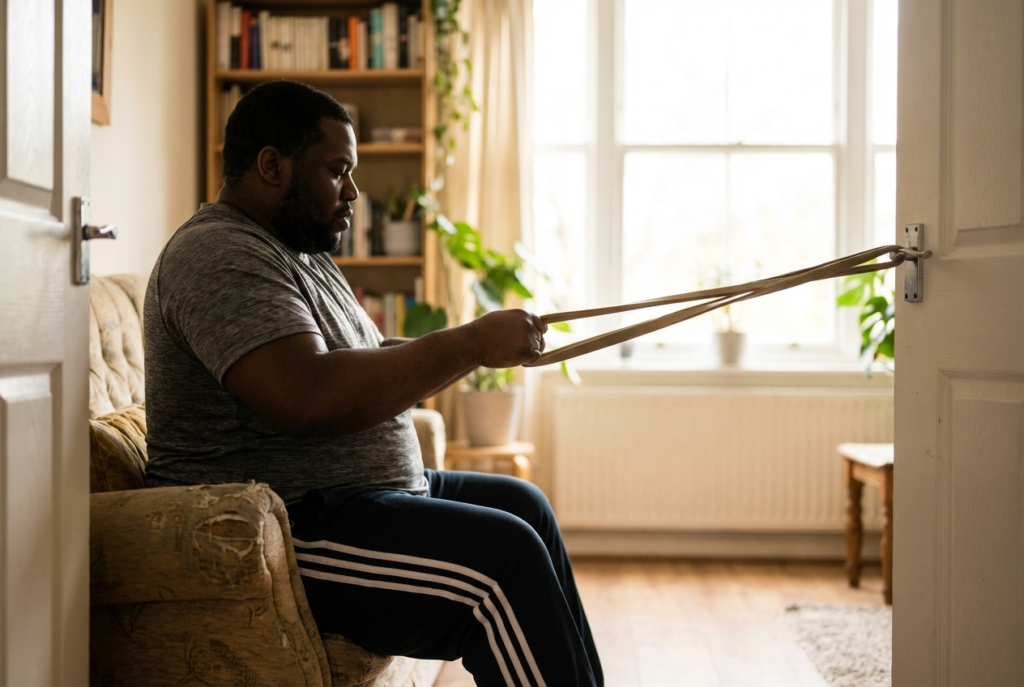
Cardio burns calories but doesn’t provide the mechanical stimulus your muscles need to maintain or grow. That stimulus comes from lifting — weights, resistance bands, your own bodyweight against gravity. When you apply load to a muscle, your body repairs it by making it slightly stronger and denser. This process, supported by adequate protein, is what preserves and builds lean mass.
Excessive cardio while in a large caloric deficit can actually contribute to muscle loss. An hour on the treadmill when you’ve only eaten 1,000 calories is a recipe for your body to cannibalize muscle for energy. Choose strength training first.
How Much Protein You Need Alongside Exercise
Exercise and protein are a package deal. Resistance training creates the stimulus for muscle protein synthesis — but protein provides the raw materials. Without adequate protein, even perfect training won’t fully protect your muscle.
Target: 0.7–1 gram of protein per pound of goal body weight per day. If your goal weight is 160 lbs, aim for 112–160g daily. On a suppressed appetite, protein shakes become genuinely important — not as a replacement for whole food, but as a practical tool to hit targets when eating full meals feels impossible.
Try to get 20–40g of protein within a couple of hours of your strength training session to support muscle repair.
Timing Workouts Around Injection Day
Your energy levels are not consistent across the week on a weekly GLP-1 injection. Work with this cycle:
- Injection day and day after: Rest or gentle walks only. This is not the time to push hard — your body is dealing with the medication’s peak effects.
- Days 2–3 post-injection: Light activity is fine. Moderate workout if side effects are minimal for you.
- Days 4–7 (toward end of week): Best window for your hardest workouts. Energy is returning, nausea has passed, and you can push closer to your actual capabilities.
A Practical Beginner Routine
Phase 1: Weeks 1–4 (Bodyweight Foundation)
2–3 times per week, at least one rest day between sessions. Each session: 20–30 minutes.
- Chair sit-to-stands: Stand up from a chair and sit back down slowly. 3 × 10. (This is a squat.)
- Wall push-ups: Stand arm’s length from a wall and do push-ups against it. 3 × 10.
- Standing hip hinges: Push hips back as if closing a car door with them, then stand up. 3 × 12. (Deadlift pattern.)
- Standing calf raises: Rise onto your toes and lower. 3 × 15.
- Resistance band rows: Anchor a band at chest height, row toward your midsection. 3 × 12.
- Dead bug (core): Lie on your back, knees bent at 90°, arms up. Extend opposite arm and leg slowly while pressing low back to floor. 3 × 6 per side.
Phase 2: Weeks 5–8 (Add Load)
Once Phase 1 movements feel comfortable, add resistance. Replace chair squats with dumbbell goblet squats. Replace wall push-ups with incline push-ups or floor push-ups. Add dumbbell rows, shoulder press, and Romanian deadlifts with light weights. The principle: progressive overload — gradually increasing the challenge. If the weights feel easy, they’re not doing enough. The last 2–3 reps of each set should feel like genuine effort.
What to Do When Nausea Makes Exercise Hard
- Don’t push through significant nausea. Rest is legitimate on bad nausea days.
- Walk instead. Even a 15–20 minute gentle walk maintains the habit of daily movement without intensity that might trigger nausea.
- Exercise in the morning on an empty stomach — many find this causes less nausea than exercising after meals.
- Stick to seated or standing movements when nausea is present. Avoid positions that require lying flat or bending.
- Hydrate before exercise. Dehydration worsens nausea significantly.
- Give it time. For most people, nausea decreases significantly after 4–8 weeks and after each dose increase settles.
Walking: The Most Underrated Exercise for GLP-1 Users
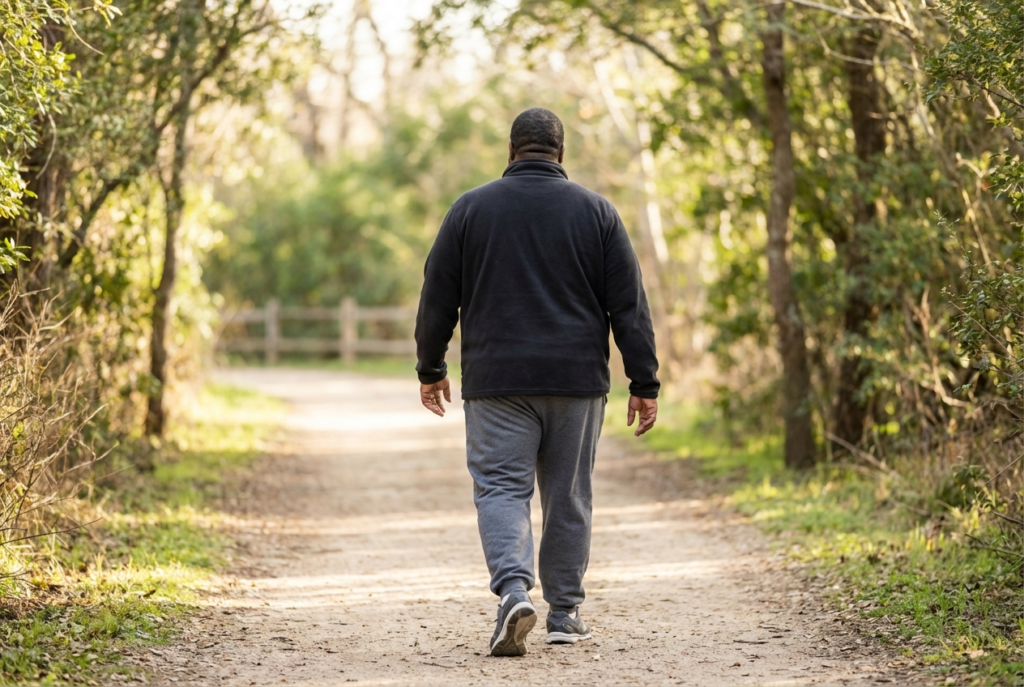
Walking often gets dismissed as “not real exercise” — which is wrong. Research consistently shows that regular walking improves insulin sensitivity, reduces cardiovascular risk, supports weight maintenance, and improves mood and sleep. A 2023 analysis found that even 3,967 steps per day was associated with significantly reduced risk of death from any cause.
- Start with whatever you can manage without feeling wiped out — even 10 minutes counts
- Build toward 7,000–10,000 steps per day over several weeks
- Add a 10–15 minute walk after meals specifically — post-meal walking significantly blunts blood sugar spikes and supports digestion
- Use walking as “active recovery” on rest days between strength training sessions
Exercise and the Weight Loss Plateau
Virtually everyone on GLP-1 medication hits a plateau. As your body weight decreases, your caloric needs decrease, and the caloric deficit driving weight loss narrows or disappears. Exercise is one of the most effective tools for breaking through.
Resistance training, as it builds muscle, raises your resting metabolic rate. More muscle means more calories burned at rest. If you’re in a plateau, before changing your dose or dramatically cutting calories, try: adding or increasing resistance training sessions, increasing daily step count, reviewing protein intake, and examining whether poor sleep or high stress is affecting cortisol and metabolism.
A Weekly Exercise Structure for GLP-1 Users
- Injection day (e.g., Monday): Rest or short gentle walk only
- Day after injection (Tuesday): Walk 20–30 minutes; prioritize hydration
- Day 3 (Wednesday): Moderate activity — longer walk, light resistance training if feeling well
- Day 4 (Thursday): Strength training session (full body, 30–45 min)
- Day 5 (Friday): Walk or light cardio; active recovery
- Day 6 (Saturday): Strength training session (full body, 30–45 min)
- Day 7 (Sunday): Rest or recreational activity — hiking, swimming, cycling
Two resistance training sessions per week is the minimum that’s genuinely sufficient for muscle preservation when combined with adequate protein. As fitness improves and side effects lessen, add a third session or more structured cardio.
The Bottom Line
The medication opened the door. Exercise is how you walk through it and stay on the other side. Start where you are — walk if that’s what’s possible today. Add bodyweight exercises when you’re ready. Get to the gym when it makes sense. Keep protein high. Work with your injection cycle, not against it.
Every bit of muscle you preserve or build during this process is an investment in a metabolism that works better for the rest of your life.
This article is for informational purposes only and is not a substitute for professional medical advice. Always consult your healthcare provider before starting a new exercise program, especially while on GLP-1 medication.